The Short Answer: Boiling Water Won’t Melt PVC — But It Can Damage It
Boiling water sits at 100°C (212°F). Standard rigid PVC begins to melt only between 160°C and 210°C (320°F–410°F). So no, a pot of boiling water will not turn PVC into liquid. But that does not mean PVC is safe around hot water or high ambient temperatures — and this distinction matters a great deal for anyone specifying building materials.
PVC is an amorphous thermoplastic. Rather than snapping from solid to liquid at one precise point, it passes through a softening zone first. Understanding that zone is where things get practical.
Three Temperature Zones Every Buyer Should Know
PVC behavior under heat follows three recognizable stages:
| Temperature Range | What Happens to PVC | Risk Level |
|---|---|---|
| 60–87°C (140–189°F) | Glass transition — material shifts from rigid to rubbery; begins to lose structural stiffness | Caution under load |
| 100–140°C (212–284°F) | Significant softening; pressure-rated pipe loses most of its load capacity; panels can warp or bow | High risk of deformation |
| 160–210°C (320–410°F) | True melt range for processing; PVC flows and can be extruded or molded | Full structural failure |
The takeaway: boiling water at 100°C sits right inside the danger zone for rigid PVC under load. A pipe carrying water under pressure at that temperature will not hold. A wall panel installed on a south-facing facade in a hot climate may see surface temperatures exceeding 70–80°C on dark-colored surfaces — enough to push the material past its glass transition and cause visible bowing.
Why Standard PVC Struggles in Hot Climates
Heat from direct sunlight is a different problem from hot water, but the physics is the same. On a 40°C day in the Middle East or Southeast Asia, a dark-colored standard PVC panel absorbs solar radiation and can reach surface temperatures of 70–85°C — well above the glass transition point. The result is gradual distortion, color fading, and surface chalking over time.
The root issue is UV degradation combined with thermal stress. Standard PVC does not contain inherent UV stabilizers. Without them, UV radiation breaks down the polymer chains, accelerating both color change and heat sensitivity. A panel that handles 70°C in year one may start deforming at 60°C by year three.
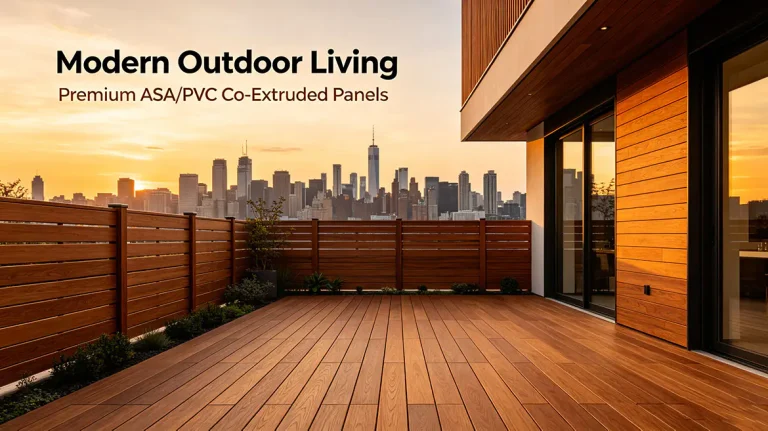
This is why the outdoor building industry has largely moved toward co-extruded ASA/PVC composite structures for facade, decking, and wall cladding applications.